By law, anyone who works on gas appliances in your home as a business must be on the Gas Safe Register, under the Gas Safety (Installation and Use) Regulations 1998. Check the engineer's ID card, including the back, and confirm the licence number with Gas Safe Register. Radiators and radiator valves are water-side jobs, not gas work.
Who can legally work on a gas boiler in England?
Regulation 3 of the Gas Safety (Installation and Use) Regulations 1998 says nobody may work on a gas fitting unless competent, and anyone doing gas work as a business must belong to the class of persons approved by the Health and Safety Executive. In practice, that means being on the Gas Safe Register.
Gas Safe Register's own guidance puts it simply: by law, anyone who comes to fit, fix or service your gas appliances, pipework and flues must be on the Register. That covers boilers, gas fires, gas cookers and hobs, and gas water heaters.
Regulation 3 also says no person shall falsely pretend to be registered. HSE strongly advises having all gas appliances, flues and pipework serviced at least once a year by a Gas Safe registered engineer.
What counts as gas work under the 1998 Regulations?
Regulation 2 of the Gas Safety (Installation and Use) Regulations 1998 defines work on a gas fitting as installing or reconnecting it, maintaining, servicing, permanently adjusting, disconnecting, repairing, altering or renewing it, purging it, moving it where it is not readily movable, or removing it. Gas fittings include gas pipework, valves, meters and appliances.
Gas Safe Register's factsheet on who can legally work on a gas appliance adds that this list is not exhaustive, so other jobs can count as gas work too. What you can do yourself is limited to the tasks the manufacturer's user instructions describe for the user, such as replacing a cooker control knob.
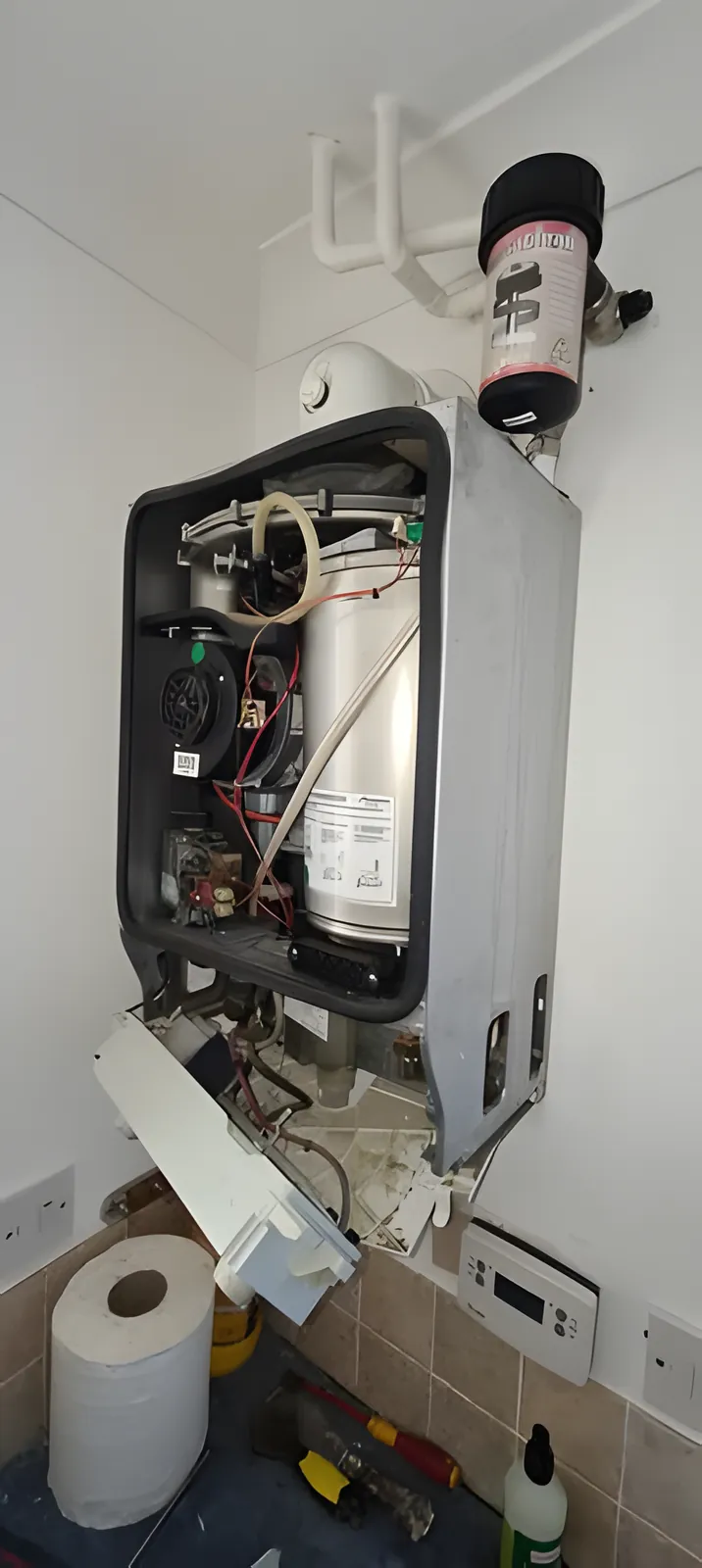
The factsheet also covers taking the case off an appliance. A purely decorative cover that lifts off or swings open can usually be removed, following the manufacturer's instructions. If removing the case means undoing a number of screws, it is normally a functional case that seals the gas and combustion parts, and only a Gas Safe registered engineer should remove it.
How do I check a Gas Safe engineer's ID card?
Every Gas Safe registered engineer carries a Gas Safe Register ID card with a unique licence number. Gas Safe Register's guidance says the card shows the engineer's name, the business name and details of their qualifications, and HSE says the card tells you which appliances the engineer is qualified to work on.
Check the card before work starts, not afterwards. Read the name and licence number, and check the dates. The sample card in Gas Safe Register's overview leaflet shows a licence number, a business registration number, and 'valid from' and 'expires' dates on the front.
If anything does not match, or the engineer cannot show a card, do not let the work go ahead. HSE's advice in September 2026 was plain: if they are not on the register, do not let them through the door. You can report someone you think is working illegally to Gas Safe Register.
What does the back of a Gas Safe ID card show?
The back of a Gas Safe ID card lists the types of gas work the engineer is qualified to do, and HSE says an engineer's competencies are clearly marked there. On Gas Safe Register's sample card, categories such as pipework, cooker, fire, water heater and gas boiler each carry a date, with separate columns for gas and LPG.
The sample card states that the cardholder is deemed competent only in the categories of work identified by a date. An engineer qualified for boilers is not automatically qualified for a gas fire or a cooker, so match the category to the job, such as gas boiler for a boiler service.
Cards also separate domestic work from non-domestic work. For a house or flat, check the domestic categories.
How do I check an engineer is on the Gas Safe Register?
To check an engineer is registered, enter the licence number from their ID card into the Check an Engineer service on the Gas Safe Register website, or call Gas Safe Register on 0800 408 5500. HSE says the online check shows pictures of registered engineers and details of their qualifications.
A logo on a van or a flyer is not proof. In September 2026, HSE reported that 17 people had been convicted for illegal gas work since the start of 2025, compared with three convictions in 2022/23 and four in 2023/24. One trader it prosecuted used a fake Gas Safe logo on flyers, and had only been on the Register until 1 February 2024 before carrying on working.
Checking the licence number on the day shows whether the engineer is registered now, not just at some point in the past.
Which central heating jobs are not gas work?
Water-side heating work, such as bleeding, replacing or adding radiators, changing radiator valves or flushing sludge out of the pipework, does not touch gas fittings as the 1998 Regulations define them. Gas Safe Register says even a non-gas part inside the boiler casing, such as the pump, can be replaced by another competent tradesperson.
That comes with limits. Gas Safe Register's factsheet says it only applies when the work can be done without breaking a combustion chamber seal, disturbing any gas-carrying component, or disturbing a module that controls the combustion process. If any of those are involved, it is gas work for a Gas Safe registered engineer.
As a rule of thumb, radiators, radiator valves, thermostatic radiator valves and the water pipes between them are water-side. The boiler's burner, gas valve, flue and gas supply pipe, and any gas hob, cooker or fire, are gas work.
Water-side jobs can still have their own rules. GOV.UK lists installing or replacing a heating system, and adding extra radiators to one, among the projects that might need building regulations approval. If your boiler's user instructions show you how to top up the pressure, that is a task the manufacturer intends you to do.
For radiator and valve jobs, send Emir a WhatsApp with photos of the radiator, the valves and the pipes for a free estimate.
Can someone fit a boiler and get a Gas Safe engineer to sign it off?
Fitting a boiler and then asking a Gas Safe engineer to sign it off is illegal. Gas Safe Register's factsheet says that when someone who is not registered fits a gas appliance or does other gas work and a registered engineer then checks it, both are breaking the law.
A new boiler also brings paperwork. Gas Safe Register advises that, in England and Wales, your registered engineer should notify the installation of any heat-producing gas appliance to your local authority, and that you keep the Building Regulations Compliance Certificate, because it may be needed when you move house.
If you rent your home, your landlord has extra duties, including arranging a gas safety check every year by a Gas Safe registered engineer and giving you a copy of the record.
What should I do if I smell gas?
If you smell gas, HSE's advice is to call the gas emergency freephone number, 0800 111 999, open all doors and windows, and shut off the gas supply at the meter control valve if you know where it is. HSE also says it is illegal to use a gas appliance you suspect is unsafe.
Turn the appliance off and leave it until a Gas Safe registered engineer has checked it. Gas Safe Register lists warning signs to act on: dark, sooty staining on or around an appliance, floppy yellow flames instead of crisp blue ones (fuel-effect fires aside), more condensation inside windows, and a boiler pilot light that keeps going out.
Gas Safe Register also recommends an audible carbon monoxide alarm marked EN 50291. HSE adds that an alarm is a useful precaution but not a replacement for regular servicing and safety checks.
Sources
- The Gas Safety (Installation and Use) Regulations 1998, regulation 3: Qualification and supervision (legislation.gov.uk)
- The Gas Safety (Installation and Use) Regulations 1998, regulation 2: Interpretation and application (legislation.gov.uk)
- Gas safety: home owners (Health and Safety Executive)
- Who can legally undertake work on a gas appliance? (factsheet) (Gas Safe Register)
- Your guide to gas safety (Gas Safe Register)
- What is Gas Safe Register? (overview with sample ID card) (Gas Safe Register)
- Families warned of risk to life from unregistered gas work amid surge in prosecutions of illegal traders (Health and Safety Executive)
- Building regulations approval (GOV.UK)
This guide explains how the rules generally work in England and is not legal advice. Checked against the sources above on 30 September 2026.